axis2,Axis2
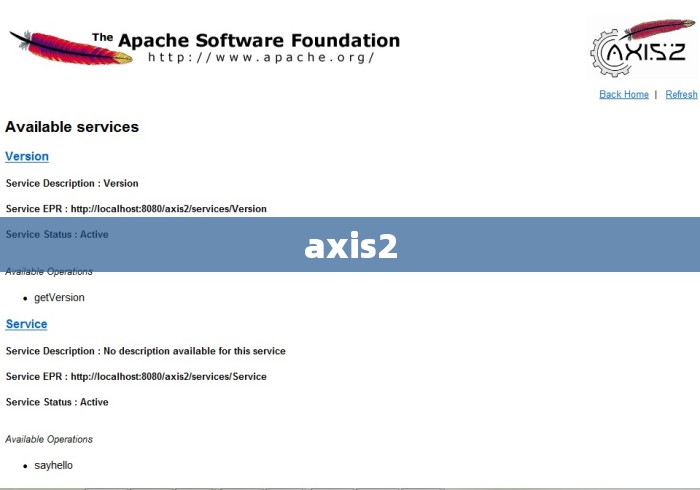
Apache Axis2 is an open-source, Java-based web services engine and framework. It is the successor to the original Apache Axis and is designed to be more modular, efficient, and extensible.
Here is a comprehensive overview of what Axis2 is, its key features, architecture, and how it compares to its predecessor.
What is Axis2?
Axis2 is a middleware framework used to build and deploy SOAP-based and RESTful web services in Java. It acts as a server-side engine to host web services and a client-side API to consume them.
It is part of the Apache Software Foundation and is widely used in enterprise Java environments (though it has largely been superseded by modern frameworks like Spring Boot and JAX-RS implementations in recent years).
Key Features
- Modular Architecture: Unlike Axis1, Axis2 is built on a modular core. You only load the modules you need, which reduces the memory footprint and improves startup time.
- Flexible Data Binding: Axis2 does not force you to use a specific data binding framework. It supports ADB (Axis Data Binding), XMLBeans, JiBX, and JAXB.
- Asynchronous Web Services: It supports non-blocking, asynchronous invocations (both on the client and server side) using callbacks and polling.
- Transport Framework: It has a pluggable transport framework. While it defaults to HTTP, it can easily be configured to use SMTP, TCP, or JMS.
- WSDL 2.0 Support: Axis2 was one of the first engines to support the WSDL 2.0 specification.
- REST Support: It allows you to expose SOAP services as RESTful services (POX/JSON) with minimal configuration.
- Hot Deployment: You can drop new
.aar(Axis Archive) files into the repository, and the server will deploy them without a restart.
Architecture
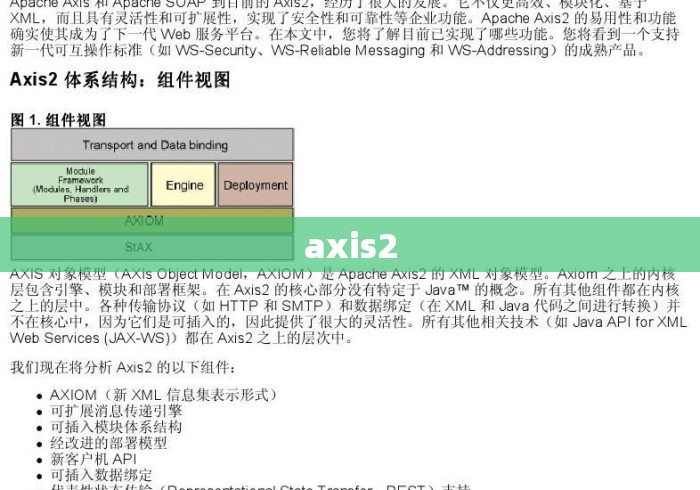
Axis2 uses a specific architecture centered around the Message Context:
- Core Engine: The central controller that manages incoming and outgoing messages.
- Handlers & Phases: Processing is done in phases. A message passes through a pipeline of "Handlers" (e.g., security, logging, addressing).
- Modules: These are extensions that add capabilities (like WS-Security or WS-ReliableMessaging) to the engine.
- Axis2 Repository: A directory structure where deployed services (
.aarfiles) and modules (.marfiles) are stored. - Transports: Listeners and Senders that handle the actual network communication.
Axis2 vs. Axis1
If you are migrating or comparing:
| Feature | Axis1 | Axis2 |
|---|---|---|
| Architecture | Monolithic | Modular |
| Performance | Slower (DOM-based) | Faster (StAX-based streaming) |
| XML Processing | DOM (loads entire XML into memory) | StAX (Streaming API for XML - low memory) |
| Extensibility | Difficult | Easy (Modules & Handlers) |
| Data Binding | Mostly ADB | Pluggable (ADB, JAXB, XMLBeans, etc.) |
| REST Support | Poor | Good |
Common Use Cases
- Legacy Integration: Connecting to older SOAP-based systems (like SAP, Oracle, or mainframes).
- WS-Security: Implementing enterprise-grade security (signing and encryption) using the Apache Rampart module.
- WS-ReliableMessaging: Ensuring message delivery using the Apache Sandesha2 module.
Pros and Cons
Pros:
- Highly configurable and extensible.
- Excellent support for WS-* standards (Security, Addressing, Reliable Messaging).
- Good performance due to StAX parsing.
- Can run standalone or inside a servlet container (Tomcat).
Cons:
- Steep Learning Curve: The configuration (XML files like
axis2.xmlandservices.xml) can be complex. - Dated: In modern microservices architecture, lighter frameworks (Spring Boot, JAX-RS) are preferred over heavy SOAP engines.
- Documentation: While extensive, some documentation is outdated.
Current Status
Apache Axis2 is still maintained, but development has slowed significantly. The last major release was 8.2 (in 2023).
For new projects, most developers choose Spring Web Services or JAX-WS/JAX-RS implementations (like Apache CXF) unless they specifically need the legacy features of Axis2. However, Axis2 remains a staple in many large enterprise environments that rely on SOAP.
Summary
If you are working with SOAP web services in Java, especially those requiring WS-Security or complex WSDL handling, Axis2 is a powerful tool. If you are building a modern REST API, you are likely better off with Spring Boot or JAX-RS.
发表评论
暂时没有评论,来抢沙发吧~